2026 Best Way to Prevent Corrosion on Outdoor Lifting Gear?

Time:2026-10-12 Author:Mason
0%

Outdoor lifting gear faces a harsh mix of rain, salt, dust, mud, and repeated mechanical wear. Slings, shackles, hooks, chain blocks, and wire-rope assemblies may look sound while corrosion develops inside joints, beneath coatings, or between wire strands. The right answer to “How to prevent corrosion on outdoor lifting gear” is not one product. It is a disciplined control system.

Dr. Mars G. Fontana, a foundational corrosion engineer, wrote, “Corrosion engineering is the application of science and art to prevent or control corrosion economically and safely.” That principle still fits modern lifting operations. Prevention begins with selecting galvanized, stainless, or suitably coated components for the actual environment. It continues with clean storage, drainage, fresh-water rinsing after salt exposure, and documented inspections. Small details matter. A wet shackle left on a steel deck can develop orange staining overnight.

This 2026 guide examines practical protection methods for outdoor lifting equipment, including coating selection, lubrication, inspection intervals, and replacement decisions. It also considers how ultraviolet exposure, trapped moisture, abrasive contact, and chemical contamination accelerate damage. Experienced teams know that corrosion control is rarely perfect. Paint can crack. Grease can attract grit. A protective cover can trap condensation when installed too tightly.

That is where careful judgment matters.

Operators should never hide pitting beneath a fresh coating or treat surface discoloration as harmless. Photographs, measured wear, environmental records, and competent inspection provide stronger evidence than appearance alone. The goal is simple: reduce corrosion before it weakens load-bearing parts, and remove questionable gear before confidence becomes guesswork.
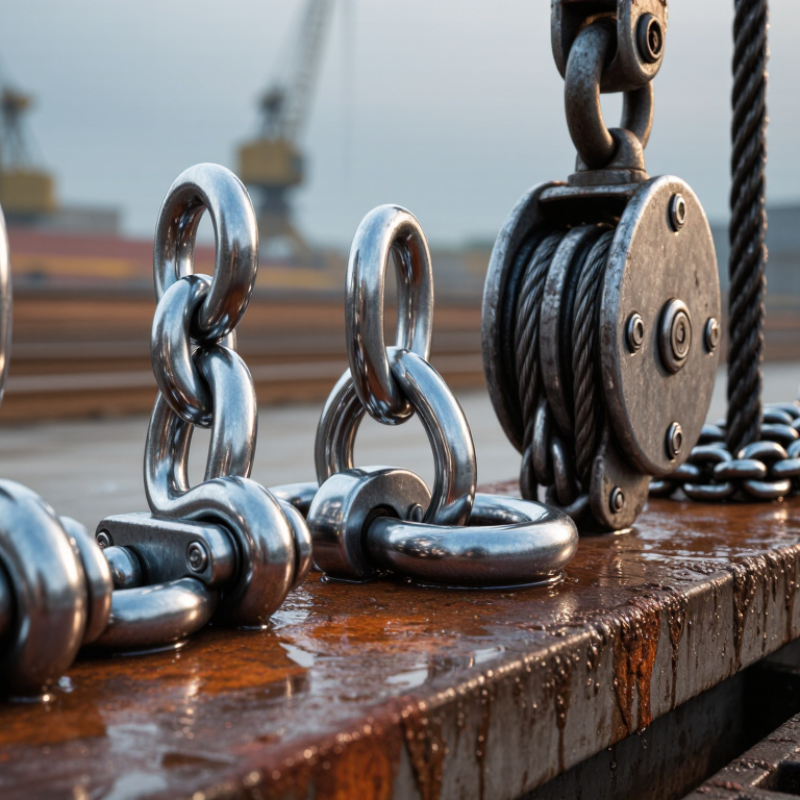
2026 Best Way to Prevent Corrosion on Outdoor Lifting Gear?

Map Exposure Using ISO 9223 Corrosivity Categories C1 Through CX

2026 Best Way to Prevent Corrosion on Outdoor Lifting Gear?

Map Exposure Using ISO 9223 Corrosivity Categories C1 Through CX

Outdoor lifting gear faces more than rain. Salt particles, industrial gases, moisture, and temperature changes can attack chains, hooks, shackles, and wire ropes. ISO 9223 helps classify this atmospheric risk from C1, very low, to CX, extreme. The category provides a practical starting point for selecting coatings, inspection intervals, and storage controls.

A dry inland warehouse may fall within C1 or C2. Urban air often reaches C3, while coastal and industrial sites can enter C4 or C5. CX conditions may occur near intense marine spray or aggressive industrial atmospheres. Do not judge exposure by distance from the sea alone. Wind direction, sheltered corners, drainage, and operating frequency can change the real corrosion pattern.

During inspections, check areas where water stays trapped. Look beneath load hooks, inside links, around pins, and near rope sockets. Surface staining is not always serious, but pitting can reduce confidence quickly. Cleaning and drying after wet or salty use remains essential. Protective treatments should match the ISO 9223 exposure category and the equipment material. A coating that works inland may fail beside a busy harbor. That mistake is easy to make.

ISO 9223 is not a guarantee of service life. It describes atmospheric corrosivity, not every mechanical or chemical hazard. Reassess the site when equipment moves, production changes, or unusual corrosion appears. Keep inspection records with photos, dates, and precise locations. Small details matter.

Choose Hot-Dip Galvanizing: ISO 1461 Targets an 85 μm Mean Coating

2026 Best Way to Prevent Corrosion on Outdoor Lifting Gear?

Choose Hot-Dip Galvanizing: ISO 1461 Targets an 85 μm Mean Coating

Outdoor lifting gear faces rain, mud, salt spray, and repeated handling. Hot-dip galvanizing protects steel by bonding a durable zinc layer to its surface. For steel sections thicker than 6 mm, ISO 1461 specifies an 85 μm mean coating thickness, with a 70 μm minimum local thickness. This measurable target supports reliable inspection and maintenance planning.

The zinc coating also provides sacrificial protection when small scratches expose the steel. It is not a magic shield. Trapped water can still cause corrosion, especially around joints, enclosed areas, and damaged threads. Before galvanizing, fabricators should provide suitable drainage and vent holes. Moving interfaces may require careful design because the coating can affect clearances. After treatment, inspect lifting points, welds, holes, and contact surfaces. Record coating measurements and repair minor damage using an approved zinc-rich system.

Tips: Clean dirt and salt from gear after coastal use. Store equipment under cover, but allow ventilation. Check for white corrosion products, deep scratches, distortion, or blocked holes before every lift. Do not assume a thick-looking surface meets ISO 1461. A trained inspector should verify it. In practice, one missed crevice can undermine an otherwise excellent coating. Recheck high-wear areas during scheduled inspections, because slings, hooks, and shackles rarely experience equal exposure.

Add Duplex Coatings Under ISO 12944 for C4, C5, and CX Conditions

2026 Best Way to Prevent Corrosion on Outdoor Lifting Gear?

Outdoor lifting gear faces rain, salt spray, abrasion, and trapped moisture. A duplex coating system offers stronger protection under ISO 12944 conditions. It combines zinc protection with a sealed paint layer. The zinc layer protects exposed steel sacrificially. The outer layer blocks water and chemicals. For C4 environments, use a properly prepared zinc-rich primer and a compatible high-build topcoat. C5 and CX conditions need stricter surface preparation, greater coating thickness, and tighter inspection. Coastal terminals, offshore platforms, and chemical sites demand special attention. ISO 12944 classifies exposure and durability, but it does not replace site-specific engineering. That part is often underestimated.

The NACE IMPACT study estimated global corrosion costs at 2.5 trillion US dollars annually, equal to about 3.4% of global GDP. It also reported that effective corrosion control could save 15–35% of those costs. For lifting equipment, savings begin with details. Round sharp edges to improve coating coverage. Remove salts before blasting. Check dry-film thickness at booms, hooks, welds, and drain points. Holiday testing can find small breaks invisible during visual inspection. Duplex systems are not maintenance-free. I have seen excellent coatings fail around poorly sealed joints. The specification was good; the preparation was not.

Tips: Confirm the ISO 12944 exposure class before selecting the system. Record surface profile, chloride readings, humidity, and coating thickness. Inspect damaged areas after every demanding lift. CX locations may need more frequent checks than the original schedule suggests.

Preventing Corrosion on Outdoor Lifting Gear with Duplex Coatings

ISO 12944 classifies atmospheric corrosivity using the expected first-year thickness loss of unprotected carbon steel. The chart shows the lower threshold for each severe exposure category. As conditions become more corrosive, a duplex system—typically hot-dip galvanizing combined with a compatible organic coating—can provide barrier protection and extended maintenance intervals.

Note: ISO 12944-2 defines C4 as 50–<80 μm/year, C5 as 80–<200 μm/year, and CX as ≥200 μm/year for carbon steel. Actual coating selection and durability depend on preparation, coating thickness, environment, design details, and inspection.

Remove Chlorides and Moisture Before Rust Reaches Load-Bearing Parts

2026 Best Way to Prevent Corrosion on Outdoor Lifting Gear?

Outdoor lifting gear faces more than rain. Salt spray, coastal air, and trapped moisture can attack pins, hooks, shackles, and load-bearing links. Chloride residue is especially dangerous because it may remain after the surface looks dry. Removing it early helps prevent rust from reaching critical parts.

During field inspections, clean visible salt with fresh, low-chloride water. Use a soft brush around pins, grooves, welds, and chain pockets. Avoid forcing debris deeper into joints. Mild cleaning solutions may help, but they must suit the gear’s materials and safety instructions. Never mix chemicals. Rinse thoroughly afterward.

Dry every surface completely. Pay attention to sleeves, drain holes, and overlapping plates. Compressed air can remove water from narrow gaps, but it should not replace visual inspection. Look for red staining, rough metal, pitting, cracked coatings, or stiff movement. A small rust spot may hide deeper damage. Do not assume a clean appearance proves the gear is safe.

Apply an approved protective product only when it will not affect grip, inspection, or load performance. Keep a dated record of washing, drying, findings, and corrective action. A competent inspector should assess damaged load-bearing parts before use. In practice, missed moisture is common. Even experienced crews overlook it after a long shift. That weakness deserves attention.

Inspect Under ASME B30.9 and EN 818 Before Every Critical Lift

2026 Best Way to Prevent Corrosion on Outdoor Lifting Gear?

Inspect Under ASME B30.9 and EN 818 Before Every Critical Lift

Outdoor lifting gear needs more than paint and occasional washing. Rainwater enters chain links, sling eyes, sockets, and damaged coatings. Salt air accelerates the attack. Rust may begin inside contact points, where ordinary visual checks miss it.

The NACE IMPACT study estimated global corrosion costs at approximately US$2.5 trillion annually, equal to 3.4% of global gross domestic product. It also reported that 15–35% of corrosion costs could be avoided through better practices. That figure makes a pre-lift inspection financially sensible, not merely procedural.

Before every critical lift, inspect wire-rope slings under ASME B30.9 requirements. Look for pitting, broken wires, crushed sections, heat damage, and unreadable identification. For alloy chain, check against EN 818 requirements and site procedures. Examine every link, especially near hooks and load-contact points. Remove gear when corrosion reduces section thickness, creates sharp edges, or prevents free movement.

Use a clean cloth first. It reveals orange dust, wet residue, and fresh cracks. Do not hide corrosion under grease. Grease can preserve metal, but it can also conceal defects. Store dry gear off the ground, drain trapped water, and record inspection results with photographs. A clean surface is not proof of strength. One missed link can change the lift.

2026 Best Way to Prevent Corrosion on Outdoor Lifting Gear? - Inspect Under ASME B30.9 and EN 818 Before Every Critical Lift
Outdoor chain slings and related lifting components should be inspected by a competent person before each critical lift, after severe exposure, and at the intervals required by the applicable standard, local rules, and manufacturer instructions.
Inspection Dimension What to Inspect Before the Lift Real-World Corrosion or Damage Indicators Required Preventive or Corrective Action Standards Alignment
Chain links Examine every link, including contact areas between adjoining links. Clean off dirt, salt deposits, and loose scale before visual inspection. Red or brown rust, pitting, flaking scale, sharp corrosion grooves, local swelling, bent links, stretched links, cracks, or distortion. Remove from service if corrosion has reduced the section, caused pitting, or is accompanied by cracking or deformation. Do not grind, weld, heat-treat, or repair a load-bearing chain link in the field. ASME B30.9 and EN 818 inspection principles; use the applicable chain sling specification and manufacturer limits.
Hook body and throat Check the hook bowl, throat opening, tip, latch, pin, and areas hidden by the latch or connected fitting. Corrosion pitting, cracks, an increased throat opening, a bent tip, damaged latch, seized latch spring, or wear at the hook bowl. Quarantine immediately any hook with a crack, severe pitting, a deformed tip, a missing or ineffective latch, or an opening beyond the applicable acceptance limit. Never tip-load a hook unless specifically designed for that use. ASME B30.9 and EN 818 requirements for hook condition, loading, and rejection; exact dimensional limits depend on the component specification.
Master links and connecting links Inspect the inside radius, weld areas where applicable, connecting pins, load-bearing surfaces, and contact points with the chain. Rust scale, pitting, gouging, cracks, elongated holes, damaged pins, loose retainers, or uneven wear caused by side loading. Do not use if a crack, significant pitting, pin displacement, or permanent deformation is found. Replace the complete compatible component and verify its rated capacity. ASME B30.9 / EN 818 component inspection and traceability expectations.
Surface section loss Compare suspicious areas with an unaffected section of the same component. Use dimensional measurement only when the responsible inspector has an approved acceptance criterion. Visible reduction in diameter or thickness, deep pits, knife-edge corrosion, or a rough surface that hides cracks. Hold for evaluation when section loss is measurable or its extent is uncertain. A visual inspection alone cannot establish a safe remaining capacity. Neither ASME B30.9 nor EN 818 should be interpreted as authorizing a universal field percentage for every component; apply the relevant specification and competent-person assessment.
Identification tag and WLL Confirm that the tag is legible and matches the chain grade, nominal size, configuration, working load limit, length, and applicable inspection records. Unreadable tag, missing tag, corrosion obscuring markings, mismatch between tag and chain, or evidence of unauthorized modification. Remove from service until the sling is positively identified, inspected, and re-tagged or replaced by an authorized party. Never guess the working load limit. ASME B30.9 and EN 818 require appropriate identification and capacity information for chain slings.
Moisture and salt exposure Review whether the gear was exposed to rain, seawater, salt spray, chemicals, immersion, condensation, or wet storage. White salt deposits, persistent dampness, accelerated red rust, chemical staining, or corrosion concentrated in crevices. Prevent recurrence by rinsing compatible steel components with clean fresh water after salt exposure, drying thoroughly, and applying an approved corrosion-control product where permitted. Follow the product and component instructions. Good maintenance practice supporting the inspection requirements of ASME B30.9 and EN 818.
Lubrication condition Check whether chain articulation points are dry, contaminated, or coated with a product incompatible with the working environment. Dry reddish friction marks, stiff links, abrasive paste, trapped grit, or lubricant attracting dirt and masking cracks. Clean and reassess before lubrication. Use a suitable lubricant compatible with the chain, temperature, chemicals, and site safety requirements. Do not lubricate a component that requires examination for hidden cracking until it has been inspected. Maintenance practice; lubricant selection must not obscure defects or conflict with the component instructions.
Welds, fittings, and attachments Inspect welded fittings, shortening devices, swivels, shackles, and any attachment point for corrosion, cracks, and restricted movement. Rust at weld toes, linear indications, undercut corrosion, seized swivels, bent fittings, missing pins, or incompatible replacement parts. Stop the lift for any suspected weld crack, seized load-bearing fitting, missing retaining part, or unauthorized repair. Obtain a documented evaluation before reuse. ASME B30.9 / EN 818-compatible assembly and inspection practice.
Chemical corrosion Identify contact with acids, alkalis, plating chemicals, cleaning agents, fertilizers, or other process chemicals before selecting the sling. Localized etching, unusual discoloration, brittle-looking surfaces, rapid pitting, or corrosion that appears disproportionate to normal weather exposure. Quarantine and obtain technical review because chemical attack may reduce strength without obvious bulk metal loss. Do not assume rinsing restores capacity. Material compatibility and manufacturer guidance are required in addition to ASME B30.9 or EN 818 inspection requirements.
Storage and drainage Check whether the sling is stored off the ground, ventilated, dry, protected from standing water, and separated from corrosive materials. Water trapped in chain piles, rust concentrated at floor-contact points, mud-filled links, or condensation inside storage containers. Improve storage by hanging or racking slings clear of the floor, allowing air circulation, draining water, and keeping them away from acids, chemicals, welding spatter, and direct weather exposure. Preventive maintenance practice supporting both standards.
After overload or shock loading Ask the lifting team whether the sling experienced shock loading, snagging, sudden braking, dropped loads, or contact with sharp edges. Permanent elongation, bent links, fresh bright impact marks, deformed hooks, unusual stiffness, or newly exposed metal. Remove from service for a documented inspection after any suspected overload or shock event. Corrosion inspection does not replace a structural damage assessment. ASME B30.9 and EN 818 safe-use principles require damaged or suspect slings to be removed from service pending evaluation.
Inspection records Verify the pre-use check, periodic inspection status, sling identification, defects found, corrective action, and inspector authorization. Missing history, overdue periodic inspection, repeated corrosion findings, or unexplained component replacement. Suspend use until verified when records are incomplete or the inspection status cannot be confirmed. Record environmental exposure and corrective actions. Inspection frequency and documentation must follow the applicable edition, jurisdiction, site procedure, and manufacturer instructions.
Important: A clean appearance does not prove that a chain sling is safe. Any crack, severe pitting, deformation, illegible identification, chemical attack, or uncertain condition requires removal from service until evaluated by a qualified person. The applicable current editions of ASME B30.9, EN 818, local regulations, and the component manufacturer’s instructions take precedence over this summary.

FAQS

Why should outdoor lifting gear be washed after exposure to salt air?

Salt residue can remain after surfaces look dry. It attracts moisture and speeds corrosion around pins, hooks, shackles, and links.

What should be used to remove chloride residue?

Use fresh, low-chloride water and a soft brush. Clean grooves, welds, chain pockets, and other areas where salt collects.

How can cleaning damage be avoided?

Brush gently and avoid pushing debris deeper into joints. Use only mild solutions suitable for the equipment materials.

Can different cleaning chemicals be mixed?

No. Never mix chemicals. Rinse the equipment thoroughly after cleaning to remove remaining residue.

Which areas require extra drying attention?

Dry sleeves, drain holes, overlapping plates, and narrow gaps. Compressed air may help remove trapped water.

What corrosion signs require careful inspection?

Check for red staining, rough metal, pitting, cracked coatings, and stiff movement. Small rust spots may hide deeper damage.

When should lifting gear be removed from service?

Remove it when corrosion reduces metal thickness, creates sharp edges, or prevents free movement. A competent inspector should assess damage.

What should be checked before a critical lift?

Inspect every link, hook, sling eye, and load-contact point. Check for broken wires, crushed sections, heat damage, and missing identification.

Can grease prove that equipment is protected?

No. Grease may protect metal, but it can also hide corrosion. A clean or coated surface does not prove strength.

How should inspection and maintenance records be kept?

Record washing, drying, findings, and corrective actions with dates and photographs. Store gear dry and off the ground.

Is this maintenance method completely reliable?

No method is perfect. Even experienced crews miss moisture after long shifts, so visual inspection still deserves extra attention.

Conclusion

How to prevent corrosion on outdoor lifting gear begins with understanding the environment. Use ISO 9223 corrosivity categories, from C1 through CX, to assess exposure to humidity, salt, industrial pollutants, and coastal conditions. This classification helps determine the right protection level. For durable steel components, hot-dip galvanizing should be selected in accordance with ISO 1461, with an average coating target of approximately 85 μm where applicable. In more severe C4, C5, and CX environments, a duplex system that combines galvanizing with a compatible protective coating under ISO 12944 can provide an additional barrier against corrosion.

Effective maintenance is equally important. Remove chlorides, dirt, and trapped moisture before rust can reach load-bearing areas, and ensure drainage and drying after outdoor use. Before every critical lift, inspect the equipment according to ASME B30.9 and EN 818, checking for coating damage, pitting, deformation, cracked links, and reduced section thickness. Any component showing questionable deterioration should be removed from service and evaluated by a qualified person before reuse.

Mason

Mason

Mason is a seasoned marketing professional with a deep expertise in the company's offerings and a passion for driving brand awareness. With a strong background in digital marketing strategies, he has an innate ability to connect with diverse audiences and effectively communicate product benefits.......