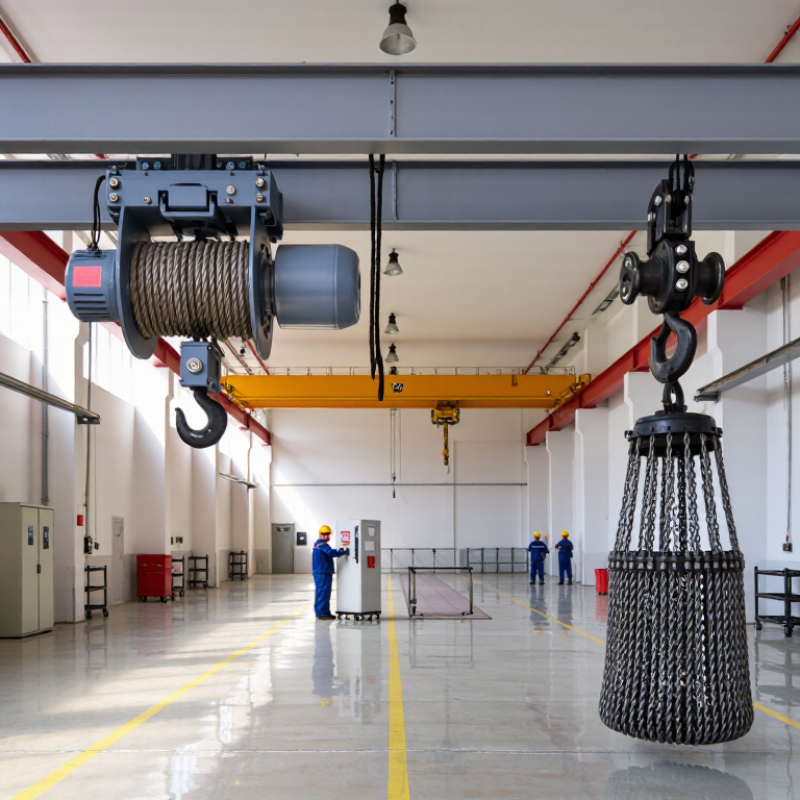
| Lifting Element and Design |
Uses a grooved drum or rope system to wind and guide steel wire rope. |
Uses a load chain, chain wheel, and chain bag or container. |
Choose according to required lifting height, duty cycle, installation space, and load-control needs. |
| Typical Rated Capacity |
Commonly available from approximately 1 tonne to more than 100 tonnes, depending on configuration and standards. |
Commonly available from a few hundred kilograms to approximately 20 tonnes; larger capacities are possible in specialized designs. |
For very heavy industrial loads, a wire rope hoist is generally the more practical starting point. |
| Lifting Speed |
Usually supports higher lifting speeds, often around 4–20 m/min for standard industrial applications; higher speeds require specific engineering. |
Often operates at lower speeds, commonly around 1.5–8 m/min, depending on capacity and drive arrangement. |
Select wire rope for productivity and frequent vertical travel; select chain where moderate speed is acceptable. |
| Lifting Height |
Suitable for long lifting heights; rope length is stored on a drum and can be engineered for substantial travel. |
Suitable for short to medium lifting heights; long lengths require sufficient space for the hanging chain. |
For lifts above approximately 6–10 m, compare chain-bag capacity, chain weight, and available clearance carefully. |
| Positioning and Load Control |
Electric models can provide smooth motion and precise control, particularly with variable-frequency drives. |
Manual chain hoists offer direct, fine load positioning; electric chain hoists provide practical control at moderate speeds. |
Use a chain hoist for simple, close-range positioning; use a controlled wire rope system for repeated production movement. |
| Horizontal Travel |
Commonly integrated with top-running or under-running bridge cranes, gantry cranes, and monorail systems. |
Often used with trolleys, jib cranes, workstation cranes, and portable lifting systems. |
For crane systems requiring high travel frequency and higher capacity, wire rope designs are often preferred. |
| Equipment Size and Weight |
Typically larger and heavier because of the motor, gearbox, drum, rope guide, and supporting structure. |
Usually more compact for comparable light and medium capacities, especially in manual configurations. |
Choose a chain hoist where low headroom, portability, or limited supporting structure is important. |
| Headroom Requirements |
Standard designs may require significant headroom; low-headroom and recessed configurations are available. |
Often offers favorable headroom in compact trolley or short-headroom configurations, but the chain container still needs clearance. |
Measure the distance between the runway or support beam and the lowest required hook position before selecting a model. |
| Duty Cycle and Frequency |
Well suited to frequent lifting, high utilization, and demanding industrial duty when correctly rated. |
Well suited to maintenance work, intermittent lifting, workshops, assembly areas, and moderate production duties. |
Use the applicable duty classification rather than capacity alone; consider starts per hour, load spectrum, and operating hours. |
| Maintenance Requirements |
Requires inspection of wire rope, drum grooves, rope guide, sheaves, brakes, gearbox, limit devices, and electrical components. |
Requires inspection of chain links, chain wheel, load brake, hooks, chain container, gearbox, and electrical components when fitted. |
Both types require scheduled inspections, lubrication where specified, and immediate replacement of damaged load-bearing parts. |
| Durability Considerations |
Performance depends strongly on correct reeving, drum spooling, lubrication, bending conditions, and protection from corrosion or crushing. |
Performance depends strongly on chain alignment, lubrication, protection from side loading, corrosion, and damaged or elongated links. |
The operating environment and maintenance quality can affect service life more than the lifting element alone. |
| Noise and Vibration |
Can provide relatively smooth operation, although drum, gearbox, trolley, and motor noise vary by design. |
May produce noticeable mechanical noise from chain engagement, especially at higher speeds or with poor lubrication. |
For noise-sensitive work areas, compare measured sound levels and select suitable speed and control options. |
| Environmental Suitability |
Can be configured for outdoor, dusty, humid, high-temperature, and hazardous areas when the enclosure and certification are appropriate. |
Can also be configured for demanding environments, but exposed chain and chain-bag conditions must be considered. |
Specify temperature, humidity, dust, corrosive chemicals, outdoor exposure, and hazardous-area requirements before purchase. |
| Typical Applications |
Steel plants, fabrication shops, warehouses, power facilities, shipyards, heavy machinery handling, and production crane systems. |
Maintenance departments, workshops, machine installation, assembly lines, service operations, and light-to-medium material handling. |
Match the hoist to the actual workflow, not simply to the maximum load shown on the nameplate. |
| Main Advantages |
Higher capacity potential, longer lifts, higher speed, smooth powered operation, and broad crane-system integration. |
Compact construction, lower initial complexity, good portability, simple operation, and precise manual positioning. |
Select the design that best balances productivity, installation constraints, purchase cost, and maintenance resources. |
| Main Limitations |
Higher system complexity, greater equipment weight, more installation requirements, and greater sensitivity to rope-related wear. |
Generally lower speed and capacity range, chain weight at long lifts, and possible chain-container or headroom limitations. |
Review the complete lifting system, including beam capacity, runway loads, hook clearance, power supply, and safety devices. |
| Best Choice When... |
The application requires high capacity, long lifting height, repeated operation, fast lifting, or integration with a production crane. |
The application requires compact equipment, occasional lifting, portability, moderate capacity, or economical maintenance handling. |
Confirm capacity, duty class, lifting height, speed, headroom, environment, control method, and applicable local regulations. |
 Glinder lift