Elevator ropes appear rigid, yet each wire moves slightly during every lift. Over thousands of cycles, that movement changes the rope’s length, shape, and internal tension. This raises a practical question for building owners, engineers, and maintenance teams: Why do elevator ropes stretch over time? The answer involves several connected factors, not one simple defect.
New ropes often show early bedding-in elongation. Their strands settle under the car’s weight, counterweight forces, and repeated bending around sheaves. Later, wear, heat, corrosion, and uneven loading may increase apparent stretch. Lubrication also matters. Too little lubricant can accelerate friction, while too much may hide damage during inspection. Rope construction, steel grade, core design, and manufacturing control all influence performance. A reliable China elevator rope supplier should provide test records, dimensional data, recommended lubrication, and clear inspection guidance. Country of origin alone does not prove quality.
Field experience shows that rope length is not the only concern. Uneven tension can make one rope carry more load than its neighbors. The car may then level poorly, vibrate, or produce unusual sounds near the sheave. Small details matter. Inspectors should compare rope diameters, measure elongation, check broken wires, and review operating history. However, a simplified explanation can mislead. Temperature, installation technique, traffic intensity, and sheave condition may change the result. I would not judge “China’s best elevator ropes” by price or appearance alone. Verified materials, controlled production, traceable testing, and competent maintenance provide stronger evidence. Professional evaluation remains essential before adjustment or replacement decisions.
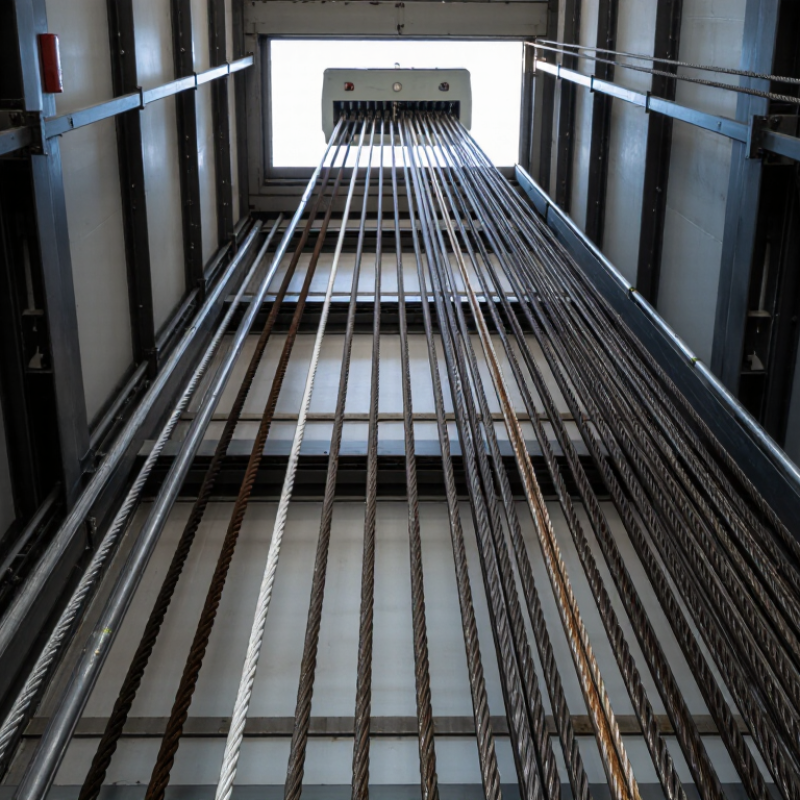
Elevator ropes used in China commonly include 8×19 and 8×25 constructions. The first number indicates eight strands. The second shows the approximate wires in each strand. An 8×19 rope usually offers a firm structure and good resistance to surface wear. It can suit installations with moderate bending demands.
An 8×25 rope contains more, finer wires. This design bends more easily around sheaves and often handles repeated flexing better. However, flexibility can increase sensitivity to poor lubrication, crushing, or incorrect sheave dimensions.
Rope stretch is not caused by one factor. New ropes experience constructional elongation as strands settle under load. Elastic elongation changes with car weight, acceleration, and tension. Temperature also affects length slightly.
During a site inspection, uneven tension often appears as different rope marks at the sheave. That detail matters. A rope may seem “stretched” when one section has settled more than another. Measuring only one rope can produce a misleading result.
Proper installation reduces early movement. Technicians should equalize rope tension, check groove wear, and record measurements at regular intervals.
The correct rope depends on load, travel height, sheave diameter, and duty cycle. An 8×25 design is not automatically better. An 8×19 design is not automatically stronger. Real installations are less tidy than catalog tables suggest, and selection should be reviewed against actual operating conditions.
The first number means eight strands. The second shows the approximate wires in each strand. An 8×19 rope has a firmer structure. An 8×25 rope uses more, finer wires.
It generally resists surface wear well. It can suit elevators with moderate bending demands. Its structure feels relatively firm during operation. That does not make it automatically stronger.
It contains more fine wires within each strand. This construction can pass around sheaves more smoothly. It often handles repeated flexing better. However, poor lubrication may affect it sooner.
New ropes undergo constructional elongation. Strands settle around the core under repeated loads. This commonly happens during early service. The movement may be normal.
Elastic elongation happens when steel strands extend under tension. The rope may recover when the load decreases. Car weight and acceleration influence this movement. Temperature also changes length slightly. Small changes matter.
Permanent elongation means the rope does not fully recover. Overloading, fatigue, corrosion, or damaged wires can cause it. The elevator may then level unevenly. Parallel ropes may also carry different loads.
Mark a fixed rope distance near the machine. Record that distance during scheduled inspections. Compare measurements with operating hours and previous records. Measure several rope sections, not just one. One reading can mislead.
Inspect groove wear, rope diameter, lubrication, and broken wires together. Check tension between parallel ropes. Look for different rope marks at the sheave. A rope can look acceptable while internal wires weaken. That uncomfortable possibility deserves attention.
No. Visible stretch is not a complete rejection limit. Inspectors should review constructional settling, diameter loss, corrosion, and wire damage. They should compare findings with applicable safety requirements. Cutting the stretched section may not solve the cause. I might sound cautious. That is intentional.
Why do elevator ropes stretch over time? The answer lies in the rope’s construction, materials, and operating conditions. Common designs such as 8×19 and 8×25 use multiple strands of steel wires, allowing flexibility while carrying heavy loads. During service, ropes experience elastic elongation under tension, constructional elongation as wires and strands settle, and permanent elongation caused by wear, fatigue, or excessive loading. Wire strengths of approximately 1,570–1,960 MPa provide high tensile capacity, but strength alone cannot prevent gradual length changes.
Sheave bending, repeated load cycles, uneven loading, and insufficient or excessive lubrication can accelerate stretching and internal wear. Regular inspection should monitor rope diameter, lay length, tension balance, broken wires, and changes in length. Stretch becomes a safety concern when it affects leveling accuracy, traction, or the required reserve capacity. Evaluation should follow applicable requirements such as ISO 4344 and EN 12385-5, while the commonly applied 12:1 safety factor helps ensure the rope’s rated strength remains suitable for its working load.

 Glinder lift